Market Volatility and Staying the Course
After several weeks of diplomatic tensions, over the last few days the word has watched in shock as Russia invades Ukraine. Geopolitical risks are difficult to predict and even more difficult to manage for within a portfolio context. In recent years we have seen growing tensions between China and the US, North Korea agitate, and ongoing conflicts in the Middle East, such as the Syrian conflict. Typically, markets tend to react sharply and quickly to geopolitical events. If we look at how markets reacted during the Gulf War in the early 90s when Iraq invaded Kuwait, the S&P 500 feel sharply but also recovered quickly. The chart below shows the drawdown from previous peak in the market. While every conflict is different, markets like certainty and a clear direction. Until that time, expect markets to be volatile.
S&P 500, Drawdown from previous peak (%)
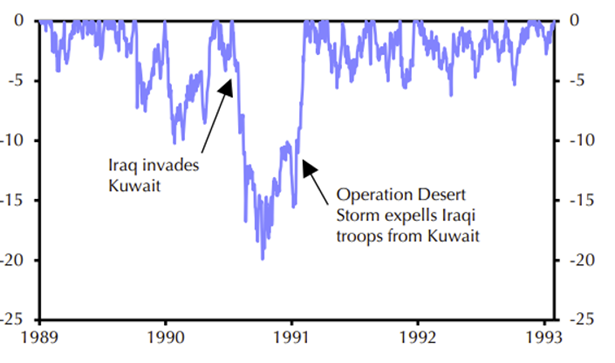
Source: Capital Economics
As we see the Russia/Ukraine conflict escalate our expectation is that energy prices will continue to increase given Russia is a large oil and gas producer and Europe relies heavily on Russian energy. A significant development has been the move to block Russian banks from the SWIFT global payments system and freeze the Bank of Russia’s reserves which are expected to severely restrict movement of capital from Russia. We also saw the decision by Germany to suspend the Nord Stream 2 gas pipeline project, a gas pipe connecting Russian gas to Germany. This is significant because Germany essentially shut down its nuclear power stations opting for gas via the new Russian pipeline. It will be interesting to observe whether this will be a catalyst for Europe to rethink their energy sources to reduce their reliance on Russian gas.
(Source: lonsec.com.au)
As we have learned from previous
periods of volatility, it is important not to react emotionally in such periods
and focus on fundamentals. In periods of market volatility quality assets often
get oversold. During the last two years we have witnessed a record level of new
retail investors enter the market, as reflected by the surge in new online
share trading accounts being opened and for many this will be their first
encounter
with a market downturn. No doubt there will be some nervous investors.
We are monitoring the developments in the conflict and are assessing the potential impact on client portfolios. Portfolios remain well diversified and hold alternative and defensive assets such as infrastructure, short-duration fixed interest funds and cash to “weather the storm”.
Now is not the time to panic and to “stay the course”.
More Articles

Complex rules of small business CGT concessions can present challenges
The complex rules around small business capital gains tax concessions can eliminate tax on a business sale and...

IGR predicts drawdowns will be major source of retirement income
Drawdowns from superannuation are projected to increase to almost six per cent of gross domestic product (GDP...

Retirees hardest hit by inflation
Retirees are being hit harder by rising prices than the general population, with the costs that dominate their...

The retirement gap we don’t talk about
Retirement confidence isn’t just about your nest egg, it’s about your plan. Retirement...

The three phases of retirement: Key decisions at every stage
Retirement starts long before your last day at work. Retirement starts long before your last day at...

Children as SMSF dependents very complex
The definition of children as dependants under superannuation law is not straightforward when dealing with...

Two Cautionary Tales About Resources Important to Anyone Using a Domain Name or Website
This warning is new, but the reason for forgetting to renew a domain name isn’t. 1. Not renewing...

Check out the smartest species on earth: Data from 200M BC to 2026
Check out the evolution of animal intelligence from the Jurassic Period (~200 million years ago) to 2026...
Heathmont Financial Services Pty Ltd (ABN 68 106 250 104) trading as Heathmont Financial Services is a Corporate Authorised Representative (No. 262098) of Knox Wealth Management Pty Ltd (ABN 74 630 256 227), Australian Financial Services Licence Number (AFSL) 513763.
Julian McGoldrick is an Authorised Representative (No. 262098) of Knox Wealth Management Pty Ltd AFSL 513763.