Portfolio Construction & Diversification
By: Sofie Korac, Principal Adviser
Prudentia Financial Planning Pty Ltd
When it comes to investing, I’m sure you have heard of the saying “don’t put all your eggs in one basket!” What does this mean and how does this translate to creating a diversified portfolio?
A diversified portfolio means investing into a range of different assets and asset classes that have different performance and risk characteristics. In addition to this, the assets need to perform differently at different points in the market cycle.
The below chart shows a technical representation of the correlation between different asset classes:

Source: Lonsec
How to interpret the numbers:
+1.00 = 100% positive correlation between two assets i.e. performance of both assets move in the same direction over a period of time. For example, if the value of one asset goes up, so does the other. Likewise, if the value of one asset goes down, so does the other.
-1.00 = 100% negative correlation between two assets i.e. performance of the two assets move in the opposite direction over a period of time. For example, if the value of one asset goes up, the value of the other asset goes down, and vice versa.
0.00 = no correlation between two assets i.e. sometimes the value of the two assets move in the same direction and sometimes in opposite directions. There is no relationship between the performances of the two assets.
The closer the number is to +1, the greater the positive correlation. The closer the number is to -1, the greater the negative correlation.
Note: Correlation does not relate to actual performance. A positive correlation does not mean two investments perform the same, it just means they move in the same direction.
In a diversified portfolio, you ideally want there to be little or no correlation between the various investments used. However, in reality it can be difficult to achieve this as correlations between asset classes don’t stay static. The correlation between two assets may be neutral or negative during normal market conditions, but may become more highly correlated during a market crisis.
We saw this last year when bonds and equities both lost value over the same time period. These two asset classes normally have negative correlations. Bonds are generally used to help protect a portfolio when equities fall in value during a bear market. When there is an economic downturn, interest rates usually fall which is good for bonds and helps stimulate the economy. Last year however, we say rising inflation leading to rising interest rates and a slowing economy resulting in falling asset prices within bonds, equities and property. The perfect storm you could say.
But this year, it seems to have reversed. Both bonds and equities have made a strong recovery. Some assets have recovered better than others, while some have had a further decline in value.
You might then ask, why don’t we just invest in the best performing assets?
We know from experience, that past performance does not always equal future performance. The chart below shows the performance of different asset classes over the years.
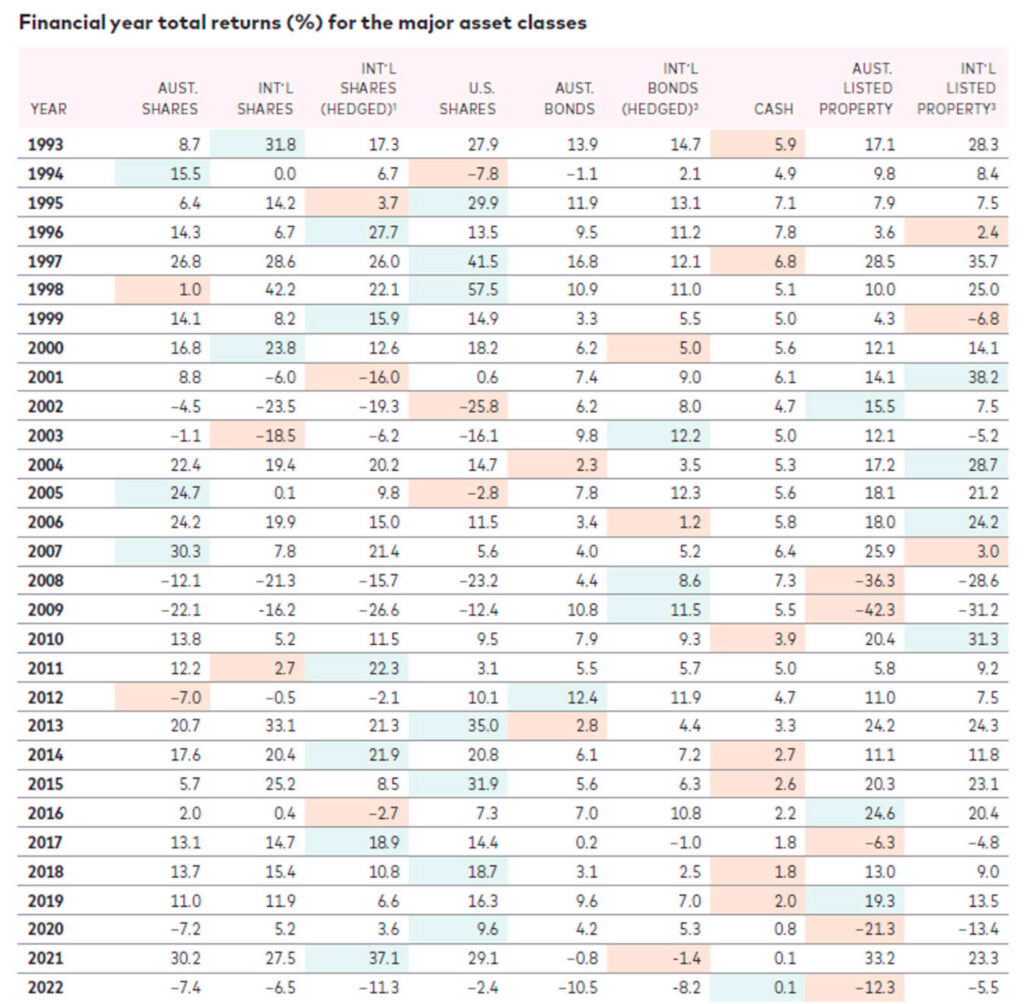
Source: Vanguard
You can see on the last row that the 12 months to 30 June 2022 was an unusual year in that all asset classes fell in value including cash, if you take into account inflation.
It is almost impossible to predict future performance of an asset class consistently over time. Having a portfolio that has a broad level of diversification means we don’t have to second guess the market. Regular re-balancing between the various assets ensures you take advantage of market movements when they occur and to maintain your desired level of risk within the portfolio. Regular investing of cash also ensures your wealth continues to grow and compound over time.
Successful investing depends not on market timing or picking the winning investment, but rather on broad diversification, keeping a long-term perspective and the discipline to stay invested when things get tough.
More Articles

Tokenisation to change SMSF landscape
The tokenisation with regard to the ownership structure of conventional assets will have a profound impact on...

Super viewed as mortgage solution
A high number of people plan to use super to extinguish their mortgage as more people expect to retire still...

How to turn your annual SMSF investment strategy review into a genuine analytical exercise
Many SMSF trustees see the annual investment strategy review as a compliance obligation. Many SMS...

SMSF pension shortfall – when can trustees self-assess?
Few SMSF compliance issues create as much anxiety as discovering a minimum pension hasn’t been...

CSLR levy on SMSFs unfair
The Institute of Public Accountants has criticised the government’s intention to impose a levy on SMS...

Financial literacy in Australia: Where we’re improving (and falling behind)
How well do we understand our money? How well do we understand our money? Most of us make...

Five steps towards a more confident retirement
Small steps today could make a big difference to how you feel about retirement. Small steps today...

Check out the largest castles by country
Check out the largest fortresses by country. Only existing fortresses that stand today are...
Heathmont Financial Services Pty Ltd (ABN 68 106 250 104) trading as Heathmont Financial Services is a Corporate Authorised Representative (No. 262098) of Knox Wealth Management Pty Ltd (ABN 74 630 256 227), Australian Financial Services Licence Number (AFSL) 513763.
Julian McGoldrick is an Authorised Representative (No. 262098) of Knox Wealth Management Pty Ltd AFSL 513763.