Returns rebound in 2022-23
Investment markets rebounded in 2022-23. But it’s important to understand that asset class returns vary from year to year.

.
Specific points in time can be useful for investors, although they’re generally less relevant over the long term.
Take the end of the 2022-23 financial year on Friday 30 June for example. It marked the end of a 12-month period during which fears about deteriorating economic conditions spurred ongoing volatility on global investment markets.
It was a similar story a year earlier at the end of the 2021-22 year as markets volatility led to negative investment returns across most asset classes, from shares to bonds.
Yet, despite the persistent volatility, 30 June 2023 marked a sharp turnaround in investment returns from the end of the previous financial year.
After falling more than 10% in 2021-22, the Australian share market as measured by the S&P/ASX 300 Index (which tracks the share prices of the 300 biggest companies listed on the Australian Securities Exchange) regained almost all of its lost ground.
From 1 July 2022 to 30 June 2023 the S&P/ASX 300 Index rose by just under 9.4%.
It was an even stronger 12-month period for investors on the United States share markets. The S&P 500 Index, which tracks the top 500 companies there, fell more than 11% in 2021-22. But between 1 July 2022 and 30 June 2023 it completely erased that loss by rebounding around 17.7%.
Meanwhile, after recording a fall of more than 10% in financial year 2021-22, the Australian fixed interest (bond) market – measured by the Bloomberg AusBond Composite 0+ Year Index – ended the 2022-23 financial year with a positive return of more than 1.2%.
That sharp turnaround in nominal, non-inflation-adjusted, terms largely reflects the impact of rising interest rates, which fuelled strong investor inflows into Australian and international bonds.
Just a line in the sand
The end of each financial year is relevant to many Australian investors from a taxation perspective.
Income distributions such as share dividends and bond coupon payments received over the period generally need to be recorded and declared by taxpayers for tax purposes.
Likewise, taxpayers generally need to record all their buy and sell transactions made during the financial year to track net capital gains and losses, also for tax purposes.
However, aside from the requirement to complete and lodge an income tax return with the Tax Office after 30 June each financial year, the crossover from one financial year to the next is merely just a line in the sand. Trading on investment markets will always resume on the first business day of a new financial year, typically changing all the market returns that were recorded as at the close of business at the end of the previous financial year.
Five financial years of returns
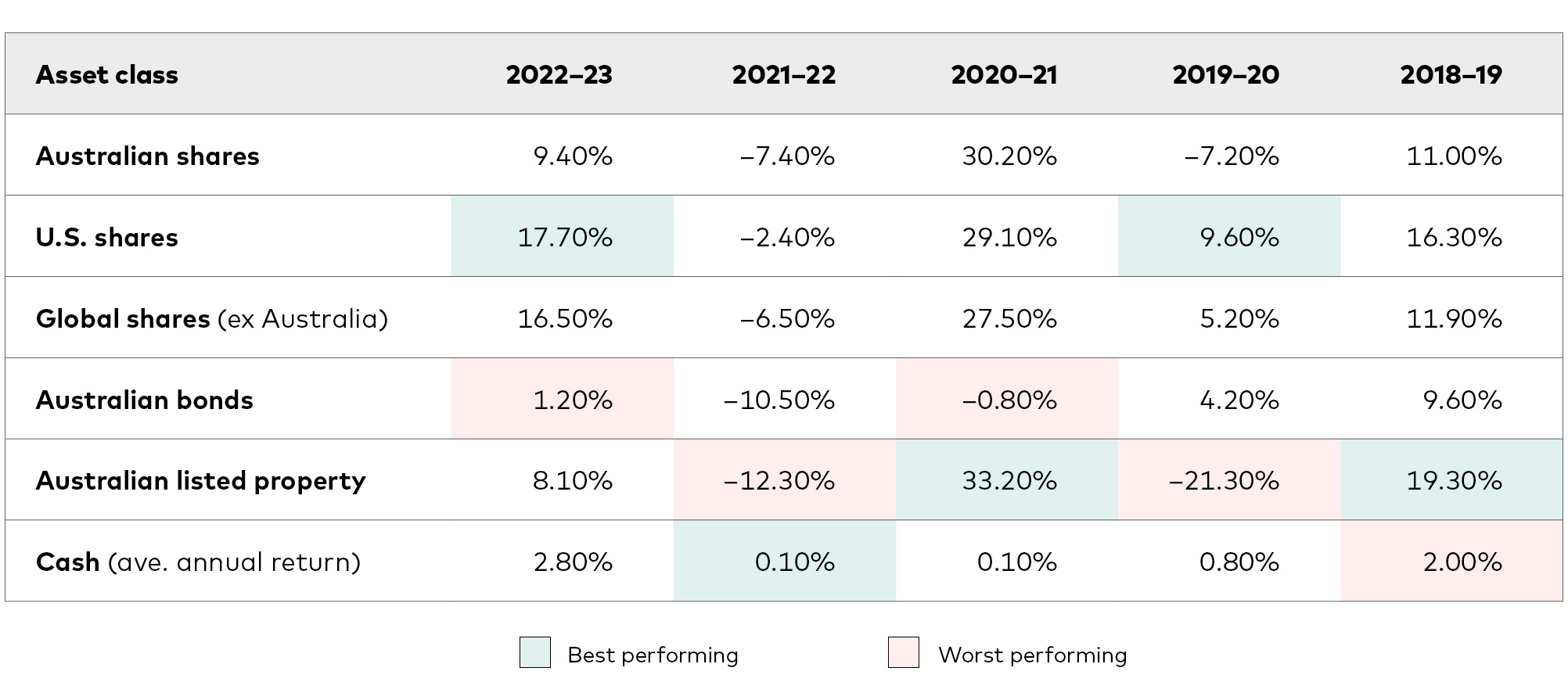
Sources: S&P/ASX 300 Index (Australian shares); S&P 500 Index (U.S. shares); MSCI World ex-Australia Net Total Return Index (Global shares ex Aust); Bloomberg AusBond Composite 0+ Year Index (Australian bonds); S&P/ASX 200 A-REIT Total Return Index (Australian listed property); Reserve Bank of Australia’s Official Cash Rate (Cash).
Out of all of the asset classes listed above, in 2022-23 the U.S. share market produced the highest return, followed by global shares excluding Australia. In the previous financial year cash was the only asset class listed to deliver a positive return – albeit that after inflation, the purchasing power of cash savings declined.
High inflation levels are continuing to erode cash returns, and over the long term cash has produced the lowest return of all major asset classes.
The bottom line
When deciding where to invest, it’s important to understand that the best and worst performing asset classes will often vary year to year.
Successful investing often benefits from having a good balance of asset classes.
Rather than trying to pick the winning investment each year, spreading your investments across a wide range of assets may help to reduce the risk of loss over longer periods that could occur if you had all your capital tied to just one asset class.
Investors who are well diversified tend to enjoy a smoother investment ride over the long term.
Long-term returns data also suggests that time in the market will deliver consistent growth over longer periods despite periods of short-term volatility.
Tony Kaye, Senior Personal Finance Writer
vanguard.com.au
vanguard.com.au
More Articles

Complex rules of small business CGT concessions can present challenges
The complex rules around small business capital gains tax concessions can eliminate tax on a business sale and...

IGR predicts drawdowns will be major source of retirement income
Drawdowns from superannuation are projected to increase to almost six per cent of gross domestic product (GDP...

Retirees hardest hit by inflation
Retirees are being hit harder by rising prices than the general population, with the costs that dominate their...

The retirement gap we don’t talk about
Retirement confidence isn’t just about your nest egg, it’s about your plan. Retirement...

The three phases of retirement: Key decisions at every stage
Retirement starts long before your last day at work. Retirement starts long before your last day at...

Children as SMSF dependents very complex
The definition of children as dependants under superannuation law is not straightforward when dealing with...

Two Cautionary Tales About Resources Important to Anyone Using a Domain Name or Website
This warning is new, but the reason for forgetting to renew a domain name isn’t. 1. Not renewing...

Check out the smartest species on earth: Data from 200M BC to 2026
Check out the evolution of animal intelligence from the Jurassic Period (~200 million years ago) to 2026...
Heathmont Financial Services Pty Ltd (ABN 68 106 250 104) trading as Heathmont Financial Services is a Corporate Authorised Representative (No. 262098) of Knox Wealth Management Pty Ltd (ABN 74 630 256 227), Australian Financial Services Licence Number (AFSL) 513763.
Julian McGoldrick is an Authorised Representative (No. 262098) of Knox Wealth Management Pty Ltd AFSL 513763.