Why most investors want human advice
Artificial intelligence systems, and their ability to undertake often complex tasks in seconds, are increasingly gaining attention and user traction.

.
Yet, when it comes to personal finances and investing, it’s evident humans definitely have the upper hand on AI.
By humans, we’re talking about licensed financial advisers specifically – qualified, industry professionals able to deliver high-level, tailored financial solutions covering personalised goals, investment strategies and estate planning.
A Vanguard survey of more than 1,500 advised U.S. investors found that most people prefer dealing with human advisers when it comes to their financial planning.
In fact, of the investors surveyed using a financial adviser, 76 per cent said that if they decided to leave their current adviser they would switch to another person (not a digital service).
A further 17 per cent said they would combine human advice and digital services, while only 4 per cent said they would switch purely to a digital advice service.
The remaining 3 per cent said they wouldn’t search for a new human adviser at all and would instead choose to manage their own investments.
The advice most valued by investors
So, what do investors want from an adviser? This can broadly be broken down into three main areas: portfolio, financial, and emotional outcomes.
Portfolio value is the outcome of building a well-diversified portfolio tailored to an investor’s preferences. Vanguard found that advised investors on average believe their advisers add 5 per cent to their annual portfolio performance.
Financial value revolves around planning to achieve desired financial goals. The surveyed investors also believe advice provides high financial value and adds 16 per cent to their attainment of financial goals.
In dollar terms, this means people with the median financial goal of $1 million will be $160,000 closer to achieving it compared to unadvised investors.
Emotional value embodies the idea of financial peace of mind. Vanguard found that investors reported a 56 per cent increase in their peace of mind when they engaged the services of a financial adviser.
Humans vs machines
Having quantified that investors believe advice provides portfolio, financial and emotional benefits, the next question comes down to how most people prefer to have advice delivered.
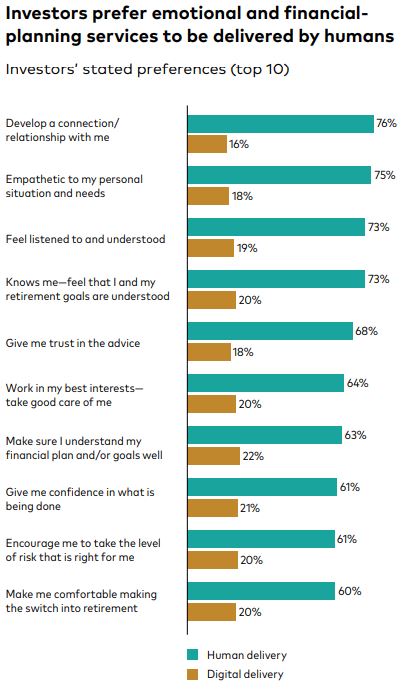
There is a strong preference for human delivery of many advice services; it is preferred over digital delivery by at least 40 percentage points.
More importantly, most of these preferences align to the emotional and financial value areas of advice rather than the portfolio dimension.
The top 10 areas where investors participating in the survey indicated the highest preference for human advice delivery are shown in the chart below.
Source: Vanguard research report. Quantifying the investor’s view on the value of human and robo-advice. February 2022
Developing a personal relationship, showing empathy, listening, having a real understanding of needs, and providing trust are all key areas where investors feel an adviser can add true value.
So are things like taking good care, providing financial education, confidence, encouragement, and comfort around important decisions such as moving into retirement.
“Traditional economics assumes people are rational but in reality, behavioural biases exist and we tend to have less self-control than we believe – so that’s where financial advisers can step in and help,” says Paulo Costa, Vanguard’s Senior Behavioural Economist.
“Advisers can harness the human element of financial advice and provide the emotional value clients most appreciate: coaching them through macroeconomic changes such as rising interest rates, keeping them on track to meet their investment goals, and being a trusted consultant”.
For the full research report and more detail on the value of human and digital advice.
Tony Kaye
Senior Personal Finance Writer
vanguard.com.au
More Articles

Complex rules of small business CGT concessions can present challenges
The complex rules around small business capital gains tax concessions can eliminate tax on a business sale and...

IGR predicts drawdowns will be major source of retirement income
Drawdowns from superannuation are projected to increase to almost six per cent of gross domestic product (GDP...

Retirees hardest hit by inflation
Retirees are being hit harder by rising prices than the general population, with the costs that dominate their...

The retirement gap we don’t talk about
Retirement confidence isn’t just about your nest egg, it’s about your plan. Retirement...

The three phases of retirement: Key decisions at every stage
Retirement starts long before your last day at work. Retirement starts long before your last day at...

Children as SMSF dependents very complex
The definition of children as dependants under superannuation law is not straightforward when dealing with...

Two Cautionary Tales About Resources Important to Anyone Using a Domain Name or Website
This warning is new, but the reason for forgetting to renew a domain name isn’t. 1. Not renewing...

Check out the smartest species on earth: Data from 200M BC to 2026
Check out the evolution of animal intelligence from the Jurassic Period (~200 million years ago) to 2026...
Heathmont Financial Services Pty Ltd (ABN 68 106 250 104) trading as Heathmont Financial Services is a Corporate Authorised Representative (No. 262098) of Knox Wealth Management Pty Ltd (ABN 74 630 256 227), Australian Financial Services Licence Number (AFSL) 513763.
Julian McGoldrick is an Authorised Representative (No. 262098) of Knox Wealth Management Pty Ltd AFSL 513763.