How costs can add up
There is quite a bit of truth to the old adage “there is no free lunch in life” or its more recent equivalent “if you’re not paying for the product, you’re the product” because pretty much everything in life comes at a cost these days.

Which is probably why many of us ascribe a certain value to items we pay for, in a sliding scale, depending on what we pay for the product. In other words, the more we pay for something, the more valuable we tend to think it is. And following that train of thought, the more we pay for something, the more likely it is to be of a certain quality.
But while that might hold true for items like clothing, cars or computers, the same cannot be said for investment products. When it comes to investing, if all other factors are equal, an investor would likely be better off choosing the product that costs less. Because every dollar paid in costs, is a dollar less in returns. And over time, these costs do add up.
The chart below illustrates just how much these costs add up over 45 years for a portfolio that returns an average of 5% annually, before costs. The difference of 0.33% in a fund’s management expense ratio (MER) does not seem like much at first but over the course of the long-term, it does add up… to nearly $80,000.
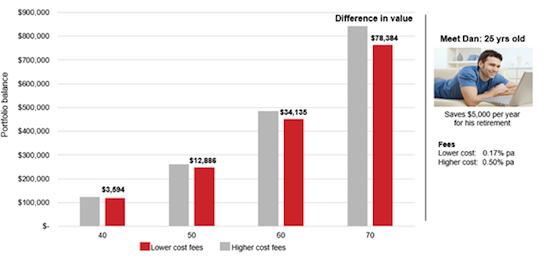
Source: Vanguard, using data from Morningstar.
Note: The portfolio balances shown are hypothetical and do not reflect any particular investment. The final account balances do not reflect any taxes or penalties that might be due upon distribution. Assumption: 5% returns less MER. The example is illustrative only and is based on the factors stated.
But MERs are not the only costs in investing. Generally, there are two types of costs or fees that investors should be aware of, transaction fees and ongoing fees.
Transaction fees are fees charged every time you execute a transaction. For instance, brokerage costs or spreads if applicable, when you buy a managed fund or ETF.
Ongoing fees are expenses that are incurred on a regular cadence, such as an annual account maintenance fee, custodian or administrative fee.
It is also important to note that the focus on fees is not limited to investments outside super but also your superannuation fund. If you’ve selected a specific super provider for its low MER, make sure that you’ve also looked at other possible costs such as contribution fees (the fee on each extra sum you put into your investment), administrative fees or any other fees you might be charged.
So just like how it makes sense to shop around for the best price on a car, computer or service, make sure you do your research and calculate how much you are paying in investment costs. And if you find a better provider or fund, be sure to consider the consequences of selling out of your existing fund or transferring your assets before you make the move.
Vanguard
vanguard.com.au
More Articles

Complex rules of small business CGT concessions can present challenges
The complex rules around small business capital gains tax concessions can eliminate tax on a business sale and...

IGR predicts drawdowns will be major source of retirement income
Drawdowns from superannuation are projected to increase to almost six per cent of gross domestic product (GDP...

Retirees hardest hit by inflation
Retirees are being hit harder by rising prices than the general population, with the costs that dominate their...

The retirement gap we don’t talk about
Retirement confidence isn’t just about your nest egg, it’s about your plan. Retirement...

The three phases of retirement: Key decisions at every stage
Retirement starts long before your last day at work. Retirement starts long before your last day at...

Children as SMSF dependents very complex
The definition of children as dependants under superannuation law is not straightforward when dealing with...

Two Cautionary Tales About Resources Important to Anyone Using a Domain Name or Website
This warning is new, but the reason for forgetting to renew a domain name isn’t. 1. Not renewing...

Check out the smartest species on earth: Data from 200M BC to 2026
Check out the evolution of animal intelligence from the Jurassic Period (~200 million years ago) to 2026...
Heathmont Financial Services Pty Ltd (ABN 68 106 250 104) trading as Heathmont Financial Services is a Corporate Authorised Representative (No. 262098) of Knox Wealth Management Pty Ltd (ABN 74 630 256 227), Australian Financial Services Licence Number (AFSL) 513763.
Julian McGoldrick is an Authorised Representative (No. 262098) of Knox Wealth Management Pty Ltd AFSL 513763.