Bull vs Bear
An explanation of the difference between a Bull and Bear run.
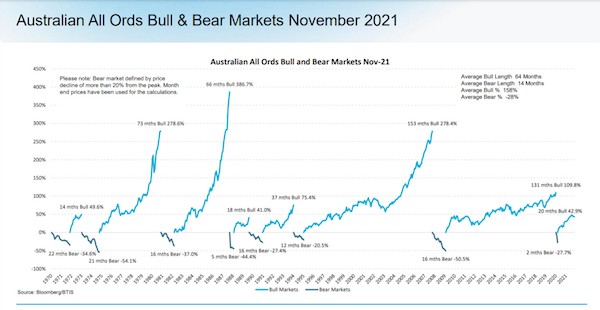
The terms ‘Bull’ market and ‘Bear’ market are always in the news and most know what they
mean, though a brief definition is noted below. The point of this chart is to allow us to see
more detail on Bull and Bear periods in regard to the Australian All Ords since 1970. A
quick snapshot, but interesting.
What is a bull market?
A market is referred to as a ‘bull’ market when the share market is showing confidence. It is
essentially a market in which share prices continue to rise, encouraging buying. After a
sustained period of increasing share prices, investors gain faith that the uptrend will continue
in the long-term. In a typical bull-market, the country’s economy is strong and
unemployment is low.
A market may be called a bull market after a number of ‘bullish’ days in succession, but the
technical criteria for a bull market is a rise in the value of the market by 20%.
What is a bear market?
‘Bear’ markets are the opposite of bull markets, and while there’s no hard and fast rule, the
generally-accepted definition is that they occur when the markets fall by more than 20%. In
bear markets, the prices of securities are falling, and widespread pessimism among investors
caused by the falling prices leads to self-sustaining negative sentiment.
More Articles

Complex rules of small business CGT concessions can present challenges
The complex rules around small business capital gains tax concessions can eliminate tax on a business sale and...

IGR predicts drawdowns will be major source of retirement income
Drawdowns from superannuation are projected to increase to almost six per cent of gross domestic product (GDP...

Retirees hardest hit by inflation
Retirees are being hit harder by rising prices than the general population, with the costs that dominate their...

The retirement gap we don’t talk about
Retirement confidence isn’t just about your nest egg, it’s about your plan. Retirement...

The three phases of retirement: Key decisions at every stage
Retirement starts long before your last day at work. Retirement starts long before your last day at...

Children as SMSF dependents very complex
The definition of children as dependants under superannuation law is not straightforward when dealing with...

Two Cautionary Tales About Resources Important to Anyone Using a Domain Name or Website
This warning is new, but the reason for forgetting to renew a domain name isn’t. 1. Not renewing...

Check out the smartest species on earth: Data from 200M BC to 2026
Check out the evolution of animal intelligence from the Jurassic Period (~200 million years ago) to 2026...
Heathmont Financial Services Pty Ltd (ABN 68 106 250 104) trading as Heathmont Financial Services is a Corporate Authorised Representative (No. 262098) of Knox Wealth Management Pty Ltd (ABN 74 630 256 227), Australian Financial Services Licence Number (AFSL) 513763.
Julian McGoldrick is an Authorised Representative (No. 262098) of Knox Wealth Management Pty Ltd AFSL 513763.