Investors and recessions
Despite much talk of rising interest rates and possible recession, here are a few reasons to stay the course and stick to your long-term investment strategy.
By Alexis Gray, Senior Economist, Vanguard Asia-Pacific
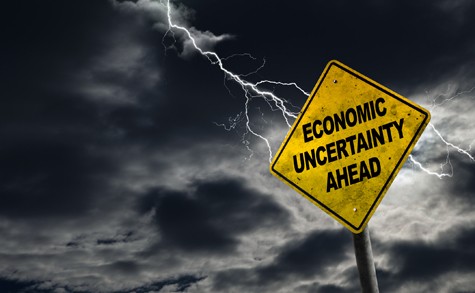
There has been much discussion of rising interest rates, recent inflation spikes and ongoing market volatility impacting investment and super balances. Add to that the increased chatter about the possibility of Australia falling into a recession and things certainly aren’t looking too hopeful for investors at present.
But before you start panicking and thinking about whether you should adjust your portfolio to weather a possible recession, here are a few reasons to stay the course and stick to your long-term investment strategy.
Firstly, a recession is often defined as two consecutive quarters of GDP contraction, and while there is indeed a more meaningful risk of recession emerging, particularly in Europe, Vanguard modelling has estimated the chances of this happening at around 35% over the next 12 months in Australia, and 45% over the next 24 months, which is to say, it is not our base case scenario.
The Australian economy continues to grow, supported by low unemployment and robust household spending. Australia is also benefiting from high global energy prices, given our status as a net exporter of energy-related commodities such as coal. As interest rates rise at home and abroad, we expect economic growth to soften, however, it should not be sufficient to trigger a recession.
Secondly, thanks to the contraction in both fixed income and equity markets earlier this year, equities previously perceived to be overvalued are now at a fairer price. In addition, current market valuations and higher interest rates mean our analysis is forecasting slightly higher returns in financial markets over the long-term, in comparison to previous projections. Our 10-year annualised return forecasts for global equity markets are largely 1.5 percentage points higher than at the end of 2021, while our fixed income return forecasts in many regions are 1.5 percentage points higher. This spells good news for both equity and fixed income investors who have the discipline to stay invested and focussed on long-term objectives.
Also, while the turbulence in the share markets has somewhat petered out, investors should recognise that the volatility experienced this year is far from unusual. Rather, it is a factor that tends to spike when equity markets undergo a severe contraction. That said, the inevitable troughs that investors will experience over time often give way to higher peaks.
Thirdly, while there is no guarantee Australia will avoid a recession, investors could perhaps look to the past to help calm their nerves. Vanguard analysis using US stock market data over the last 48 years found that share markets tend to recover soon after recessions started. The earliest recovery began a mere two months after the COVID-induced economic downturn in 2020, while the recovery after the 2007-2009 Global Financial Crisis commenced 16 months into that recession.
If you’re still dreading the thought of suffering further losses in anticipation of a possible recession and resolute about moving your investments to cash, consider this final point – Vanguard analysis has found that selling down during past recessions has proved to be a costly mistake for many investors. Those investors locked in their losses permanently because they were out of the market at the wrong time and thus weren’t able to benefit when it rose again.
All this to say, regardless of whether Australia – or any other country or region – goes into a recession, investors should tune out the noise and not use today’s headlines to make short-term decisions for an investment portfolio with a long-term time horizon. Afterall, there’s been little evidence that timing the market delivers rewards. If anything, it has been quite the opposite.
Vanguard
More Articles

Complex rules of small business CGT concessions can present challenges
The complex rules around small business capital gains tax concessions can eliminate tax on a business sale and...

IGR predicts drawdowns will be major source of retirement income
Drawdowns from superannuation are projected to increase to almost six per cent of gross domestic product (GDP...

Retirees hardest hit by inflation
Retirees are being hit harder by rising prices than the general population, with the costs that dominate their...

The retirement gap we don’t talk about
Retirement confidence isn’t just about your nest egg, it’s about your plan. Retirement...

The three phases of retirement: Key decisions at every stage
Retirement starts long before your last day at work. Retirement starts long before your last day at...

Children as SMSF dependents very complex
The definition of children as dependants under superannuation law is not straightforward when dealing with...

Two Cautionary Tales About Resources Important to Anyone Using a Domain Name or Website
This warning is new, but the reason for forgetting to renew a domain name isn’t. 1. Not renewing...

Check out the smartest species on earth: Data from 200M BC to 2026
Check out the evolution of animal intelligence from the Jurassic Period (~200 million years ago) to 2026...
Heathmont Financial Services Pty Ltd (ABN 68 106 250 104) trading as Heathmont Financial Services is a Corporate Authorised Representative (No. 262098) of Knox Wealth Management Pty Ltd (ABN 74 630 256 227), Australian Financial Services Licence Number (AFSL) 513763.
Julian McGoldrick is an Authorised Representative (No. 262098) of Knox Wealth Management Pty Ltd AFSL 513763.